Walk into any beauty shop, scroll through any skincare feed, and you'll see the same promise repeated: chemical-free, 100% natural, free from synthetics. The language is designed to feel reassuring. It implies that nature made something good, and that labs made something bad.
We want to be honest with you about this framing, because we think it's doing real harm to people trying to make good decisions about what they put on their bodies.
Everything is a chemical. Water is dihydrogen monoxide. The vitamin C in your amla oil is ascorbic acid. The moisturising factor in aloe vera is a polysaccharide chain. Every ingredient in every product you've ever used, natural or otherwise, is made of atoms bonded together. That's what a chemical is.
A blueberry contains hundreds of distinct chemical compounds. Vaseline (petroleum jelly) contains essentially one: petrolatum. By the logic of "chemical-free beauty," the blueberry is the problem.
LabMuffin Beauty Science
This article is our attempt to think through this clearly. Not to make you afraid of either natural or synthetic ingredients, and not to pretend the distinction is meaningless. Just to give you a more useful lens for evaluating the products you buy.
Where Something Comes From Does Not Determine Whether It's Safe
Castor oil is derived from castor beans. Castor beans also contain ricin, one of the most toxic substances known to science. And yet castor oil is entirely safe to use on your scalp, because the processing separates the oil from the ricin. Where an ingredient originates tells you almost nothing about whether it's safe to use.
The reverse is equally true. Petroleum jelly (Vaseline) is derived from petroleum, a fossil-fuel byproduct. It has an impeccable safety record, accumulated across more than a century of use, because the refining process removes the harmful components. The end ingredient is an inert, non-comedogenic, extraordinarily skin-compatible emollient. Its origin in crude oil is essentially irrelevant to its safety.
As LabMuffin Beauty Science explains, origin does not determine safety. The journey from plant to product, or from petroleum to product, involves processing that changes the chemistry fundamentally. What matters is what you're actually applying to your skin, not where it was sourced.
Natural Is Not Automatically Safer
This is where the "natural is safer" narrative does the most damage. Plenty of the most dangerous substances on earth are completely natural.
Botulinum toxin is produced by a naturally occurring bacteria. It is, by weight, the most acutely toxic substance known: approximately 100,000 times more toxic than dioxin, the most poisonous synthetic chemical. Arsenic is a naturally occurring element. Asbestos is a naturally occurring mineral. Monkshood, hemlock, and belladonna are all plants that cause severe poisoning or death. Giant hogweed is a plant that causes serious blistering on skin contact, even from a brief brush in the wild.
Nature, to be direct about it, is not trying to help you. Plants evolved defensive compounds to discourage insects and animals from eating them, not to nourish human skin. The fact that something grew in the ground says nothing about whether it belongs on your face.
The dose makes the poison. This principle, first articulated by the 16th-century physician Paracelsus, remains the foundation of modern toxicology. Drinking water is safe; inhaling it is lethal. Salt is essential; enough of it will kill you. Cosmetics safety science uses a minimum margin of safety of 100 times: an ingredient must be present at levels at least 100 times below any concentration at which any effect has ever been observed. This is how "safe" is actually determined.
Preservatives Are Not the Enemy
Few categories of ingredients attract more fear than preservatives. Parabens, in particular, became a target of clean beauty campaigns following a 2004 study that found paraben traces in breast tumour tissue. What was widely omitted in the reporting: the study did not establish that parabens caused the tumours, and parabens are found in many foods including blueberries. Subsequent research has not established a causal link, and parabens have accumulated more than a century of safe use in cosmetics.
The thing preservatives protect you from is very real. An unpreserved water-based product is a growth medium for bacteria, yeast, and mould. Products used near the eyes, in particular, can cause serious infections and even blindness if contaminated. The choice isn't between "clean, natural preservatives" and "harsh chemicals". It's between preservatives that work and products that may not be safe to use.
As LabMuffin has noted, the irony of the clean beauty movement is that replacing well-studied ingredients like parabens with less-tested alternatives often makes products more irritating and less predictable, not less. A preservative with 100 years of safety data is a more reliable choice than a "natural" alternative with minimal data.
Synthetic Ingredients Are Often More Consistent
Natural extracts vary significantly from batch to batch. The concentration of active compounds in a botanical depends on the growing region, soil quality, season, rainfall, harvest timing, and how the plant was processed afterward. This variability isn't a problem in traditional cooking or medicine, where a knowledgeable person adjusts accordingly. It is a problem in formulating skincare that needs to deliver consistent results.
Synthetic ingredients, by contrast, are manufactured to precise specifications. The Coco-Glucoside in one batch of product is chemically identical to the Coco-Glucoside in the next. This consistency isn't a compromise of quality. It's a feature. It's what makes it possible to reliably formulate something that performs the same way every time you use it.
Natural Ingredients Are Not Automatically Better for the Environment
The assumption that "natural" is better for the planet also deserves scrutiny. Agricultural production of botanical ingredients uses land, water, fertilizers, and pesticides. "Organic" certification is based on regulatory frameworks, not environmental science research, and some organic practices have higher environmental impacts than their conventional equivalents.
Mineral and synthetic ingredients sometimes have a lighter environmental footprint than their natural counterparts. Research highlighted by LabMuffin shows that zinc oxide, for example, can be toxic to coral at lower concentrations than some synthetic sunscreen chemicals, which is the opposite of what the "reef-safe natural" marketing would suggest. Evaluating environmental impact requires looking at the full lifecycle of an ingredient, not just its origin.
Nature does not have your skin's best interests at heart. It has its own survival interests. A plant that evolved chemical defenses against herbivores did not do so to give you a better complexion.
LabMuffin Beauty Science
How Dear Care Actually Thinks About This
We use naturally derived ingredients in our formulations because many of them genuinely perform well for their specific purpose. We do not use them because we believe "natural" is inherently superior to "synthetic." That distinction matters to us, because it changes how we make decisions.
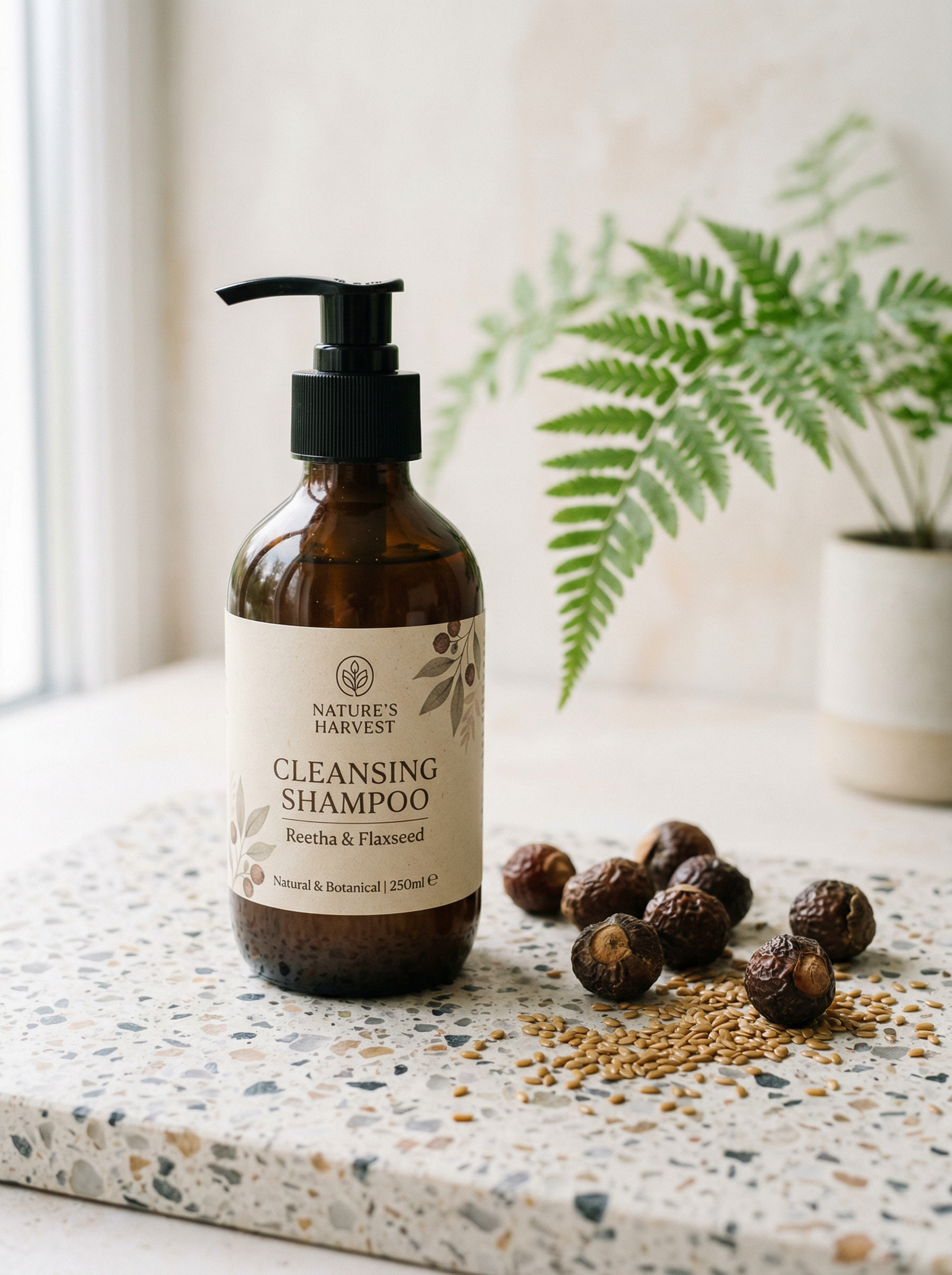
We chose reetha (soapberry) for our shampoo because saponins are genuinely effective mild surfactants with a long history of use for scalp and hair. The evidence supports their function. That's the reason. Not because it's "free from chemicals."
At the same time, we use Coco-Glucoside in the same formula, a surfactant synthesised from coconut-derived glucose. It's not from a plant in the sense that "natural" marketing usually implies, but it performs well, is gentle on the scalp, and complements the reetha effectively. We don't hide this. You'll find it clearly listed on the ingredient label.
We include Sodium Benzoate as a preservative because an unpreserved product is a genuine safety risk, not a "cleaner" product. We'd rather be transparent about that than pretend our formulations don't need preservation.
Our Certificate of Analysis is available on request because we think transparency matters more than marketing stories. If you want to know what testing our products have been through, we'll tell you.
What to Look For Instead
If "natural vs chemical" is the wrong question, what should you actually ask? Here are the questions we think matter:
Does the brand explain why they use each ingredient, not just that it's "natural"?
A brand that says "we use reetha because of its saponin content, which acts as a mild surfactant" is giving you useful information. A brand that says "we use reetha because it's natural and chemical-free" is not. The first answer tells you something about whether the ingredient will work. The second is just marketing.
Are they transparent about the full ingredient list?
Full INCI ingredient lists, in order of concentration, are a legal requirement in many markets. If a brand is reluctant to publish theirs, or buries it in fine print, ask why. Transparency is straightforward for brands with nothing to hide.
Do they provide a Certificate of Analysis or third-party testing data?
Claims about purity and efficacy should be verifiable. Independent testing and COAs are how that verification works. Brands that invest in this tend to be brands that genuinely care about what's in their formulations.
Do they acknowledge that both natural and synthetic have trade-offs?
Any brand claiming their products are "100% natural and 100% effective and 100% safe for everyone" is almost certainly not telling you the complete picture. Honest formulation involves trade-offs. Brands that acknowledge this are more trustworthy than those that don't.
Is the brand making you afraid, or making you informed?
Fear is an effective marketing tool. "Toxic chemicals" in competitor products, "harsh synthetics," "dangerous parabens" -- this is language designed to generate anxiety, not understanding. Good brands educate. They explain the science. They give you tools to make your own decisions, rather than positioning themselves as the only safe choice in a world of dangerous alternatives.
We make naturally derived products because we believe many botanical ingredients work well and deserve to be in modern formulations alongside rigorous science. We are not making 100% natural products, and we're not pretending we are. We're making formulations we believe in, with full ingredient transparency, and with a COA available to anyone who asks. That's the standard we hold ourselves to.
The beauty industry has spent years profiting from a false binary: natural is good, synthetic is bad. The reality is more interesting and more useful than that. Ingredients, all of them, should be evaluated on their evidence: their safety data, their performance data, their environmental profile, and their concentration in the final product. Origin is a starting point for a conversation, not a conclusion.
We hope this gives you a slightly sharper lens for navigating your next ingredient list. And if you have questions about anything in our formulations, write to us. We'd rather answer the hard questions honestly than avoid them.